
Most of the people that are in this hobby know that there are some Ampex tapes that have problems in the backcoated layer.
These tapes are identified easily even without playing them. Just pass the tape at high speed and if it goes slow at the middle end of the tape or sometimes even the deck's motors can't move the reels, the it's one of this bad tapes.
In the past I threw away some of these tapes to the gargabe thinking that there weren't any manner to save them, but this last week I've been trying to test some things and maybe this works for some of you.
First, make sure you have one tape that would go to the gargabe.
Place the reel in the deck and don't thread it thru the tape normal path because this would soil all the tape path and tension arms. Thread the tape directly to the take up reel. Most of the decks won't go to FF mode if some tension arm is untensioned, so use something so that the deck work in FF mode.
Take a cosmetic cottom disc and double it so that you can hold the tape inside the cottom. Tighten your fingers as much as you can againts both sides of the cottom disc and keeping them firm, press FF.
The deck won't be able to move because your fingers are doing too much force, so make a bit less force so that the tape can travel from the supply reel to the take up reel.
Be careful doing this procedure. Sometimes the tape makes force unspected tensions and the tape can break or makes the cottom disc to fly away. It's normal to stop in the middle of the run to watch how is the cottom disc. Maybe is needed to use one new because thh actual is very dirty.
Today, with a 10" reel full of Ampex 406 tape, I've used six cottom discs and made 12 times this procedure:
These tapes are identified easily even without playing them. Just pass the tape at high speed and if it goes slow at the middle end of the tape or sometimes even the deck's motors can't move the reels, the it's one of this bad tapes.
In the past I threw away some of these tapes to the gargabe thinking that there weren't any manner to save them, but this last week I've been trying to test some things and maybe this works for some of you.
First, make sure you have one tape that would go to the gargabe.
Place the reel in the deck and don't thread it thru the tape normal path because this would soil all the tape path and tension arms. Thread the tape directly to the take up reel. Most of the decks won't go to FF mode if some tension arm is untensioned, so use something so that the deck work in FF mode.
Take a cosmetic cottom disc and double it so that you can hold the tape inside the cottom. Tighten your fingers as much as you can againts both sides of the cottom disc and keeping them firm, press FF.
The deck won't be able to move because your fingers are doing too much force, so make a bit less force so that the tape can travel from the supply reel to the take up reel.
Be careful doing this procedure. Sometimes the tape makes force unspected tensions and the tape can break or makes the cottom disc to fly away. It's normal to stop in the middle of the run to watch how is the cottom disc. Maybe is needed to use one new because thh actual is very dirty.
Today, with a 10" reel full of Ampex 406 tape, I've used six cottom discs and made 12 times this procedure:

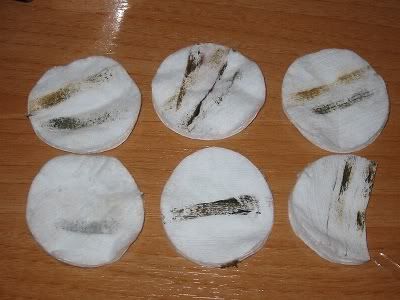
The last time, I placed isopropanol in the cottom disc to test what happened and was useful. Didn't damage the tape and cleaned well.
After all tape travels, I've recorded the longest side of a LP and cut the tape. I prefer to make short tapes from a big reel in these cases, so I make one tape = one LP (or CD).
I know that this won't convert bad tape into "as new", but maybe you can convert a "gargabe tape" into usable tape.
I've tested this method with three 10" reels, two of Ampex 478 low print and one of Ampex 406. There's no an exact numbers of travels to clean a tape. Sometimes you play the tape and the tape path or heads get dirty, so make more clean travels.


 Posts
Posts

